Making sustainability measurable - set your course with The Sustainable Packaging Compass
From packaging in a linear economy, to a recycling economy, to a circular economy. And in the long run to intrinsically sustainable packaging solutions. "That is easier said than done," says Niels van Marle, packaging expert at Verpact. "Sustainable packaging is a catch-all term. We will always have to clearly substantiate and formulate what we mean by it. In addition, there is also a need for companies to be able to assess how their packaging scores."
Supporting companies

Every day, Verpact receives questions from companies about how they can comply with new legislation and contribute to the recycling targets, or how they can make their packaging more sustainable and reduce its environmental impact. "Verpact has already developed several tools to help companies with their issues, such as the Recyclecheck. But a tool that takes into account recyclability, circularity and environmental impact does not yet exist," says Van Marle. What started with an Assessment Framework Sustainable Packaging grew into a practical tool for companies: the idea for The Sustainable Packaging Compass was born.
With The Sustainable Packaging Compass we want to help companies determine which facet of sustainability can best be addressed."
The tool is relatively easy to use. It only takes twenty minutes to run through an entire scenario and get the results. For this, a user only needs the technical data of the packaging.
"In order to train the packaging developers of the future, the tool can also be used by students from colleges and universities" continued Van Marle. "We have already gone through several cases with students from HAS Green Academy, NHL-Stenden, the Hogeschool van Amsterdam and UTwente."
The Compass calculations are based on the current situation of sorting and recycling facilities in the Netherlands. “In light of the rollout of the Packaging and Packaging Waste Regulation (PPWR), the Compass offers companies a powerful tool that can help them assess compliance with the PPWR requirements, while also providing additional insight into environmental impact,” says Van Marle.
Recyclability
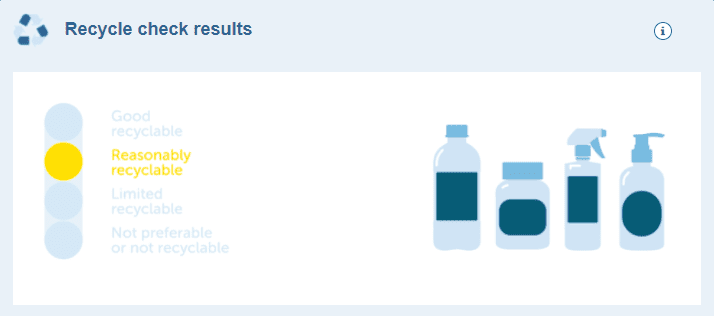
The Sustainable Packaging Compass consists of three pillars. Van Marle explains: “Each pillar—recyclability, circularity, and environmental impact—measures a different aspect of sustainability, and together they lead to the overall final result. The first pillar in the tool is recyclability. This is based on the Recyclechecks, presented in the form of a questionnaire. The Compass user only needs to enter the technical details of the packaging, after which the Recyclecheck is automatically completed. In addition, we use this digital Recyclecheck module when assessing tariff differentiation.”
Circularity
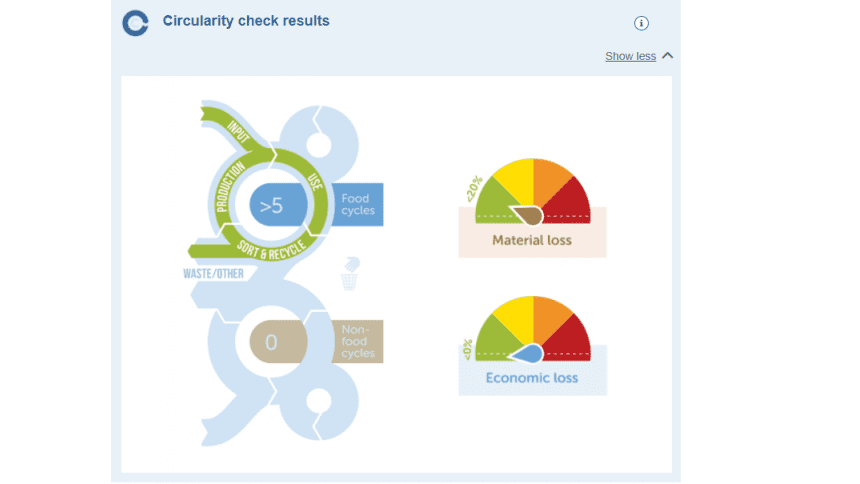
The next pillar is circularity. First of all, this step shows the extent to which materials can be reused as food grade or non-food grade material after the recycling process. Secondly, it shows the extent to which the packaging can be reused and whether there are any potential loss streams in the chain, for example through out-of-home disposal. Finally, it indicates how often the material is potentially recyclable. In addition, the tool shows how much material loss can occur in the sorting and recycling process and what the effect is on the economic value of the material. "Take a PET bottle, for example. This packaging can be reused as food-grade material after recycling. It's a different matter with a PE bottle: it can be recycled perfectly well, but unfortunately the recycled material cannot be used in food packaging."
Environmental impact
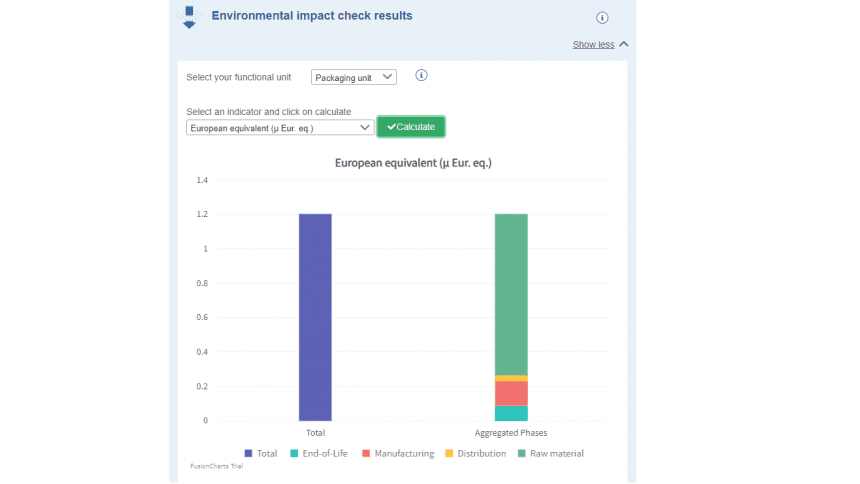
The environmental impact of packaging is measured in Compass using a simplified life cycle assessment (LCA). An LCA is a comprehensive and complex analysis that is usually carried out by a specialised agency. It takes into account the effects throughout the entire life cycle of a package, from the extraction of raw materials, through the production of the product-packaging combination and the use phase, to the disposal of packaging waste. Van Marle: "We have noticed that in many cases companies also need a rough estimate of the environmental impact, which they can carry out themselves. We have incorporated this possibility into the third pillar of the tool: environmental impact. Based on the packaging data entered by the user, the environmental impact is calculated using the Ecoinvent database. The calculation is based on fixed assumptions regarding, for example, transport distances, origin of the packaging materials and production methods. The result can be shown according to the Carbon Footprint standard or in European Equivalents standard. The latter is a standard that refers to the Product Environmental Footprint (PEF), which also takes into account effects such as water consumption, resource consumption, eutrophication of water, acidification of the air, depletion of the ozone layer, etc."
Comparison
Finally, it is possible to compare different packaging. Van Marle: "Users can, for example, immediately see the effect of a different label material or a different colour of the main component. In this way, companies can test whether certain adjustments have a small or large impact on sustainability. With the knowledge from the tool, companies can determine their course within the sustainability policy.
Click here to access the Sustainable Packaging Compass.
Note: This is the first version of the Sustainable Packaging Compass. Verpact has extensively tested the tool together with test users. Should you encounter any bugs or have any questions about the results, please contact us.